
Foreign Judgment—Updated News

In our previous blog, we said China court hardly enforce foreign judgement.  However, on June 30, 2017, the local court in Wuhan, China (“Wuhan Court”) made a verdict ordering the recognition and enforcement of a commercial judgment rendered by LA Superior Court of USA (“LA Court”).  This is the first time for a China court to recognize and enforce a commercial judgment from a U.S. court.

This dispute involved an equity transfer agreement. Though a judgement has been made in favor of the plaintiff, the defendant did not comply with the U.S. Judgment after it became effective.  The plaintiff therefore applied to the Wuhan Court to have the foreign Judgment enforced since the defendant had assets available for enforcement in Wuhan, China.

The grounds for Wuhan Court made the above verdict is as follow: 

First U.S commercial judgment enforced in China

1. Procedural requirement is met

The Plaintiff had submitted a certified copy of the U.S. judgment and a Chinese translation, which satisfied the procedural requirement for applying for recognition and enforcement of a foreign judgment;  

2. Reciprocal relationship exists

The Plaintiff had submitted evidence that precedent exists of U.S. courts (which we will elaborated in another separate blog) recognizing and enforcing civil judgments made by China courts, thereby confirming a reciprocal relationship between the two states; 

3. China’s Principles not violated

The U.S. Judgment aimed to resolve an equity transfer dispute between the two parties, which was not in violation of the basic principles of PRC law and did not damage national sovereignty, national security and public interests;

4. The judgement was made in accordance with judicial procedures

Although the foreign judgment was made in the absence of the defendant, the evidence submitted by the Plaintiff certified that the LA Court had issued summonses to the defendant.  The evidence included an investigation request lodged by the Plaintiff, an LA Court order requiring the summonses to be served by public notice and the notice as issued in newspapers;  

5. Not a substantial examination

Since the verdict was made for the purpose of offering judicial assistance, the PRC court’s did not conduct a substantial examination of both parties’ rights and obligations.  As a result, the Wuhan Court did not uphold the defendant’ arguments that the foreign judgment was flawed.

Obviously, the above-mentioned verdict sets an example for how to deal with similar matters, though in China, judgments made by local courts do not have the binding force as under case law system. But at least it demonstrates that it is possible to successfully apply to a China court for the recognition and enforcement of a foreign judgment

But still a long way to go, what do you think?

New IIT Law’s Impact on Foreigners

Since 1st of Jan, 2019, the new IIT law of PRC has come into effect. For foreigners working in China,what impact it will bring?

Except the general rule applies to everyone, the following points are important for foreigners:

1. Who should pay IIT? What kind of income is taxable?

1) Foreigners who have lived in China for accumulative 183 days or more in one tax year shall pay IIT on their income gained within or outside China. However, if this foreigner stays in China less than six consecutive years, even for each year accumulative 183 days or more, shall be exempted from IIT for his/her overseas income by filing with competent tax authority.  Moreover, if during this six consecutive years, he/she leaves china for more than 30 days once, the consecutive years will be restarted.

For example, if he/she leaves China for more than 30 days in 2023, which is the fifth consecutive years for he/she lives in China, the consecutive years will restarted in 2024.

2) Foreigners who have lived in China for less than accumulative 183 days in one tax year shall only pay IIT on their income gained within China.

2. IIT exemption

In our previous blog: Individual Income Tax in China – How to Pay in 2019?, we have listed what kind of income is taxable income.

However, the following income are exempted from IIT:

1) Awards for achievements in science, education, technology, culture, public health, sports and environmental protection granted by foreign or international organizations;
2) Insurance indemnities;
3) Basic pension.

new IIT law's impact on foreigners

3. Tax deduction or preferential treatment?

Before this new IIT, foreigners working in China could enjoy housing, language training, children’s education subsidies etc., which are all tax-free.  However, according to new IIT law, six items of expenses related to people’s livelihood could be deducted, such as children’s education, continuing education, housing rent etc.  Then the question is: do foreigners have to follow the new law or what?

According to a notice issued by General Taxation Administration, from 1st of Jan, 2019 till 31th of Dec, 2021 (transition period), foreigners could choose to enjoy the original rule on tax-free subsidies or choose to follow the new IIT law for expenses deduction.  But once he/she makes the choice, he/she has to stick to it in the whole tax year.

After the above-mentioned transition period, the original subsidies will not apply any more.  Only expenses deduction listed in new IIT law will apply.

Related link:

Implementation Regulations for the Individual Income Tax Law of the People’s Republic of China

Employee Handbook-Important Fact…

Nearly all employers know that signing an employment contract is very important. However, not all of them realize that an Employment Handbook is actually more important.

Why?

The following is our analysis:

1) Content of Employment Handbook

Generally speaking, an employment contract is a standardized document, as it is should contain the following clauses:

(1) Both party’s names, residence of each party, and other salient information;

(2) Term and probation;

(3) Work Requirements/Job Description and location where work duties are to be performed;

(4) Work hours, rest and vacation/leave;

(5) Remuneration and Social Security;

(6) Labor protection and prevention of occupational harm.

All the above-mentioned matters have to follow PRC labor laws and regulations. Otherwise, the specification is invalid as it violates labor law. These issues are mandatory and are non-negotiable—the employer does not has any alternative when preparing employment contract, as these subjects must be included, according to Chinese Labor Law.

However, the Employment Handbook is different. It not only describes the enterprise’s culture, but also sets a specific standard of behavior for employees.  In other words, it specifies what employees should do and what employees cannot do as an employee of the enterprise; it should also spell out the corresponding consequences for failure to comply with the requirements posted in the Employment Handbook. In this sense, it is a very important document to strengthen daily management of the enterprise.

2 ) Employment Handbook’s Function

A typical Employment Handbook could contain the enterprise’s management regulations, such as a statement of the enterprise’s culture and vision planning, among other things. Specific and detailed management regulations are very important for the smooth operation of the HR function and for the administrative management of the enterprise. For example, the basic requirements for employees, the recruitment procedure, probation period, leaves procedure, dissolution of labor contract, incentive system and discipline, confidential and proprietary information, code of ethical conduct, etc. The enterprise could specify every issue related to employee management in an Employment Handbook.

More importantly, the enterprise could specify clearly what kind of behavior is not allowed —what is forbidden. Any violation of these stipulations could lead to disciplinary consequences such as an oral or written warning, or even dismissal of the offending employee.

3. Procedure for an Effective Employment Handbook

In an employment handbook, the employer sets specific standard of behavior, thus make it an important paper in company management

Though the employer is the one who prepares the Employment Handbook, the employees’ involvement is also important for an Employment Handbook to be binding to the parties.

According to PRC Labor Contract Law, if any employer’s regulation/s pertains specifically and directly to the benefits of employees, such as remuneration, working hours, rest and vacation, work safety and health care, social insurance and welfare, training, work discipline or quota management, etc., the draft of such regulations shall be discussed at the employee congress or by all the employees, and shall be determined after consultation with the employer and its employees.

The employer shall publicize the Employment Handbook and make sure each employee understands the content once it is finalized.

Please note that it is very important for the employer to comply with procedural requirements in labor law.  This principle also applies to enterprise regulations.  Any above-mentioned regulations will not be authorized as effective if the employer fails to follow the procedural requirements as mandated by law. This is particularly important should there be a labor dispute wherein the enterprise cannot prove an employee’s involvement and/or awareness of the Employment Handbook. In such a case, the Employment Handbook would likely not be accepted by the Arbitration Committee (or court) to be binding upon the employee.

That is why we usually advise our clients to keep the minutes of discussion and consultation about the Employment Handbook and make sure each employee signs a statement that they clearly understand all the clauses in the Employment Handbook. Otherwise, it is possible that the employer will find they are in deep trouble someday.

Foreign Judgment-Enforceable in China?

In our previous blog: Tips on Preparing OEM Contract with China Factory, we mentioned that China court hardly enforce a foreign court judgment.  Some readers asked us to share a link of such regulations, obviously, they want to check the authenticity of such saying.

China court hardly enforce foreign judgment

Unfortunately, there is no law says so.

Let’s see what the law says.  According to the Civil Procedure Law of PRC, a foreign judgement could be recognized and enforced by China court if it:

1) meets the provisions of an international treaty concluded between or acceded to by the foreign state and China, or

2) accords with the principle of reciprocity.

Then the party concerned could directly apply for or the foreign court may request the competent court for recognition and enforcement.

Upon reviewing such application or requirement, if the court considers that such judgment neither contradicts the basic principles of the law of PRC nor violates State sovereignty, security and the public interest, then it shall rule to recognize its effectiveness and enforce it.

Actually, based on the above mentioned #1 provision, there are totally 34 countries which recognize and enforce each other’s judgement with China. Which are:

1. 12 Asian countries: Mongolia, Turkey, Kazakhstan, Cyprus, Kyrgyzstan, Uzbekistan, Tajikistan, Viet Nam, Laos, Korea, United Arab Emirates, Kuwait

2. 13 European countries: France, Russia, Italy, Spain, Poland, Romania, Belarus, Ukraine, Bulgaria, Greece, Hungary, Lithuania, Bosnia and Herzegovina:

3. 4 American countries: Brazil, Argentina, Cuba, Peru

4. 5 African countries: Egypt, Morocco, Tunisia, Algeria, Ethiopia

It’s not hard to see, few developed countries or few main trading partners of China are included in the list, such as the US, British, Germany etc. So recognition and enforcement of a judgment made in these countries may only be conditioned upon the existence of a reciprocal relationship between these countries and China. 

However, PRC law fails to clearly specify the criteria for determining whether a reciprocal relationship exists.  

Usually, a China court will determine that there exists a reciprocal relationship only if the PRC court confirmed there was a precedent of the foreign country’s courts recognizing and enforcing China court judgments. 

In fact, PRC courts have quite rarely recognized foreign court judgments absent an international treaty, and have not confirmed reciprocity in order to enforce such judgments, as long as no this foreign court’s preceding recognition and enforcement of a PRC court judgment.

Useful link:

The Supreme People’s Court of The People’s Republic of China

Work Permit for Foreigners

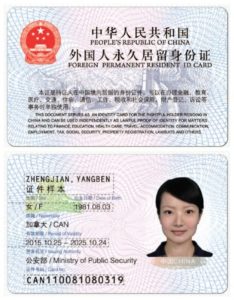
Generally speaking, expats need to get an Work Permit to work in China, unless they hold a Foreign Expert Certificate. Enterprises must apply for an Employment License after submitting the necessary documents such as resumes, qualification certificates and health certificates.  This is true even if the expatriate is the owner of the enterprise, such as a WOFE.

Work Permit is the document expats would need for working in China legally

Once an Employment License is issued, expatriates should apply for a Z visa (i.e. vocational visa in China) and then an Work Permit. Afterwards, foreigners should apply to the local public security authority for Residence Permits. With an Work Permit and Residence Permit issued, the expats can finally stay and work in China legitimately.

However, the Chief representative or representative of an overseas entity can apply for Work Permits directly, without  first applying for Work Permit, just submitting their Z visa and the RO registration certificate. 

According to related PRC regulations, the Employer shall complete an annual inspection of the Work Permit within 30 days before the expiration of the employment contract. Otherwise, the Work Permit will automatically expire. 

Additionally, if the expat changes their employer or extends their employment term without permission, the labor administrative authority can withdraw their Work Permit and the public security authority could deprive their residence qualification too.

Another thing to know about the Work Permit is, it’s the prerequisite for an expat to work in China legitimately. It is illegal for foreigners to work without Work Permits, so they are not protected by law.

What does that mean?

Let’s put it this way-most expats know employment contracts are very important to protect themselves.  However, few expats know that Work Permits are equally important. Without an Work Permit, the employment contract is meaningless.  The employer could terminate the employment contract as they wish without paying any severance pay.  The expats can only get remuneration for his/her job as specified in the contract, but they can’t get any compensation like their Chinese colleagues. This includes injuries during work that can’t be claimed for industrial injury compensation, or compensation if the employment contract expires, generally one month’s salary for each year when he/she works for the employer.

Useful links:

The Ministry of Public Security of the People’s Republic of China

Tax Reduction in China-More Details

On 18th of Jan, 2019, the General Taxation Administration and Ministry of Finance of PRC jointly announced an Notice on Implementing Inclusive Tax Relief Policies for Small and Micro-profit enterprises, following the tax reduction statement released after the State Council executive meeting on Jan 9, 2019. Over the past two days, the two government departments have made more explanations regarding to implementation of the policy.

Generally speaking, the circular and related explanations are as follows:

1. Tax-exemption

If monthly sales of a small-scale VAT taxpayer is no more than 100,000 yuan, it will be exempted from VAT.

2. Tax-reduction

Tax reduction in China

The current enterprise income tax ( EIT ) is 20%, however, according to the new policy:

If annual taxable income of a small and micro-profit enterprise is no more than 1 million yuan, EIT will be charged on 25% of the taxable income, that is, the actual tax rate is 5%;

If annual taxable income of a small and micro-profit enterprise is more than 1 million yuan but no more than 3 million yuan, EIT will be charged on 50% of the taxable income, that is, the actual tax rate is 10%.

The small and micro-profit enterprises mentioned above refer to enterprises engaged in the non-restricted and prohibited trades of the state, and meanwhile, meet the following three conditions:

1. the annual taxable income is no more than 3 million yuan;

2. the number of employees is no more than 300 people, including the number of worker who have established labor relationship with the enterprise and the number of labor dispatched to the enterprise;

3. the total assets is no more than 50 million yuan.

According to another explanation given by the Tax agency, the enterprise could declare their own reduced concessions without providing additional information.

And it’s also stated that this preferential tax policy will be effective since 1st of Jan, 2019 till 31th of Dec, 2021. And it will be applicable to all small and micro-profit enterprises, no matter in what way the tax is collected

Useful link:

State Taxation Administration

Why Is a Business License so Important in China?

Each time, when my clients complain to me about their disputes with Chinese entities, I will ask them: “Could you show me the copy of their business license?” This is because I know that few of them can tell their counterparty’s Chinese name.

business license tells very important information about a entity

Unfortunately, less than half of the clients could provide a valid business license.  Instead, they would ask: “What do you mean by business license? Why do I need it? ” Or “ Sorry, I have no such things. But I have their business cards, website and all our correspondence via email. ”

In my experience, these websites, business cards and the signature line in an email sometimes tell nothing about the true identity of people behind them. However, a business license does the job.

Why is a Business License so important?

A Business License is a certificate of company’s identity issued by the local AIC (Administration of Industry and Commerce,the corporate registration and management authority in China), just like a certificate of incorporation is in some jurisdictions.  A Business License provides basic information of an entity,including:

  • registration number,
  • name and domicile of the entity,
  • name of the legal representative (the individual who represents the entity and is authorized to sign contract on behalf of the entity),
  • registered capital,
  • type of entity (if it’s a limited liability company or any other),
  • business scope (type of business allowed to do, such as trading, consultancy, etc.),
  • date of incorporation, etc.

So, from a business license, we can tell if this entity is legally incorporated. Through the information in the business license, we can find further information, such as if this company still exists, is the company in any disputes or proceedings, or involved in other abnormal situations. All this can be done by searching in the government database (which is free of charge) or in some paid database.

In China, when people are discussing a deal, both parties will exchange their business licenses, or at least show each other a duplicate copy of the business license.  So they will know each others identity, and can do some due diligence later.

However, all websites, business cards or emails are not something issued by the government. It could tell totally false information, or even worse, no such entity could exist at all! 

Besides, all these information on the website, the business cards or the signature line in the email are in English. In China, all official documents regarding any resident or entity is in Chinese. No matter what the Chinese entity calls themselves in English, it’s not official.  You can never locate a Chinese individual or entity by an English name.  So, in any case, you should insist on a copy of their business license.

If the Chinese entity cannot present a business license, then you are probably dealing with a fraud.  If the information the Chinese entity provides you does not match up with whatever is stated in the business license, then you are probably dealing with a fraud too.

Of course, it’s not easy for a foreigner to do the check, even if the Chinese entity provides their business license.   You may wish to hire an English-speaking local lawyer to do it. It’s a very simple due diligence, but very important.

Useful Link:

State Administration for Market Regulation

Tax Deduction for IIT-More Details

In our previous post about IIT, we mentioned there is six items of special additional tax deductions which could be deducted from the taxpayer’s income, that is: children’s education, continuing education, medical treatment for serious diseases, housing loan interest, house rent, and support for the elderly. 

Now let’s see more details:

1. children’s education

RMB 1,000 per month for each kid could be deducted, if the kid is accepting pre-school education or full-time education for academic qualification.  It means from the age of three till the kid finishes his/her higher education (including junior college, undergraduate, postgraduate and doctoral education), 1000 RMB could be deducted from the taxpayer’s income or 500 RMB from the husband and wife’s perspective income for each kid.

2. Continuing Education

If a taxpayer is accepting continuing education himself/herself for academic qualification (degree) within China, RMB 400 shall be deducted per month.

3. Medical Treatment for Serious Diseases

If the accumulated amount a taxpayer has to pay by himself in a year exceeds RMB15,000, the portion above 15000RMB could be deducted, with a limit of no more than RMB80000.

For example, suppose a taxpayer has spent RMB 300000 for his medical treatment, RMB180000 of which could be reimbursed by medical insurance fund.  He has to pay RMB120000 himself.  For the portion of RMB105000, as more as RMB80000 could be deducted.

4. Housing Loan Interest

RMB1,000 could be deducted if a taxpayer is paying loan interest for purchasing his first residence, as long as the loan interest is actually incurred.  However, the longest term for the deduction could not exceed 20 years.

six items of special additional tax deductions could be deducted from the taxpayer’s income,

5. Rent

The exact amount could be deducted vary from city to city

(1) In Beijing, Shanghai, Tianjin, or capital city of a province, or Dalian, Qingdao, Ningbo, Xiamen and Shenzhen etc., it’s 1500RMB per month;

(2) Except the above-mentioned city, if the population who have local “Hukou” in a city exceeds 1 million, it’s 1100RMB per month

(3) if the population who have local “Hukou” in a city is less than 1 million, it’s 800RMB per month.

6. Support for parents


(1) If the taxpayer is the only child of his parents, RMB2,000 could be deducted per month;
(2) If the taxpayer is not the only child, the quota of RMB2,000 shall be shared among he/she and his/her siblings.  For each person, the share could not exceeding RMB1,000 per month.

Still confused about tax deduction? Please feel free to contact us for further clarification.

Useful link:

State Taxation Administration