How to Sign Contract Properly in China?

To sign a contract properly is one of the good ways to protect yourself.  But how to do it properly keeps a big issue, because of the difference in language, legal system and culture, etc.

The first suggestion I want to offer is: try to find a English-speaking PRC lawyer to help you.

To sign a contract properly is one of the good ways to protect yourself

Why? Because what you need is someone who has local knowledge and knows how things work here.  Since most of the reader of my blog is overseas SMEs, we will not recommend them to approach international law firm which is located in the landmark building in first tier city given the limited budget of SMEs, especially start-ups. I believe some local law firm maybe is a better choice. I understand it’s not easy to find an affordable, trustable and English-speaking lawyer in China, compared to finding a lawyer in your home country, but it’s worth the trouble, believe me.

The benefit of local lawyers is that they know what happens in practice and they are aware of the newest change in court in case any dispute rise.  Based on their experience in courtroom in PRC, they will give more practical suggestions that any overseas lawyer can’t offer. In one word, their job ensure the contract’s enforceability.

Once the lawyer is chosen, there are still some issues to consider while preparing the contract:

  • Which jurisdiction should I choose?
  • Which language should I use?
  • Which country’s law should be applied to?
  • What can I do if the other party choose not to honor the contract?
  • Arbitration or court, which way is better for potential dispute solution?
  • How to make sure the contract is enforceable?
  • How can I be sure that the agreement is signed by the right person?
  • What should I do before or after signing the contract?
  • Anything else?

To better explain what I am trying to say here, let’s use OEM (short for Original Entrusted Manufacture) agreement as an example, and the two party to this agreement will be overseas buyer and Chinese factory.

(to be continued)

Useful link:

MINISTRY OF COMMERCE OF THE PEOPLE’S REPUBLIC OF CHINA


Overtime Payment and Statutory Holiday

According to the law, employees can work eight hours a day and 40 hours a week. Overtime refers to hours worked outside of those 40 hours or hours worked on Statutory Holidays.

Employers may not force employees to work overtime. If for some reason employees work overtime, the employer shall compensate the worker as follows:

On workdays, the payment is 1.5 times regular salary;

On weekends, the payment is 2 times regular salary;

On statutory holidays, the payment is 3 times regular salary.

The following is an explanation of the above mentioned rule:

1. Statutory holiday

Statutory holidays including: New Year’s Day (one day), Chinese New Year’s Day (three days), Tomb-Sweeping Day(one day), Labor Day (one day), Dragon Boat Festival(one day), Mid-Autumn Festival (one day), and National Day (three days). There are 11 days in total.

2. Overtime during Statutory holidays

For overtime during weekends or workdays, the employer could allow employees to take leave which is equal to the time they worked overtime (Comp Time); however, for overtime during statutory holidays, the employer has to pay the employee three times their regular payment.

According to labor law of PRC, if for some reason they employee works overtime, the employer shall pay the worker for the overtime work

3. How to calculate overtime payment.

Firstly, we have to figure out how to calculate payment for each day, which is monthly payment divided by 21.75. Suppose Alex’s salary is 5000RMB, so his salary for each day is 5000/21.75=229.88RMB,

If he worked overtime on Monday for two hours, then his overtime payment is 2*1.5*5000/21.75/8=86.20RMB;

If he worked overtime on Saturday for two hours, then his overtime payment is 2*2*5000/21.75/8=114.94RMB,

If he worked overtime for a full day on Labor Day, then his overtime payment is 3*5000/21.75=689.65RMB.

Is it clear now?

Related provisions in the Labor law of PRC

Article 38: The employing unit shall guarantee that its staff and workers have at least one day off a week.

Article 44: The employing unit shall, according to the following standards, pay laborers remunerations higher than those for normal working hours under any of the following circumstances:

(1) to pay no less than 150 per cent of the normal wages if the extension of working hours is arranged;

(2) to pay no less than 200 per cent of the normal wages if the extended hours are arranged on days of rest and no deferred rest can be taken; and

(3) to pay no less than 300 per cent of the normal wages if the extended hours are arranged on statutory holidays.

Useful link:

Ministry of Human Resources and Social Security of the People’s Republic of China

What’s the Points-based System?

Everyone knows that Chinese government are now tightening up it’s control over work visa recent years.  The general policy is to “encourage high-end talents, control general work force and restrict low-level work force”.

According to the Evaluation Criteria for Foreigners Employed in China (trial),  foreign workers is divided into three categories A, B and C, based on various elements such as the points system, the Work Guide Directory for Foreigners, the labor market test and quota management etc. 

Generally speaking, workers in Category A are high-end overseas talents whom are encouraged to work in China, they are

1)Selected for the Domestic Talents Programs;

2) Conforming to the international criteria of professional achievement

3) Foreign talents fulfilling the market demand for government-encouraged

posts

4) Innovative and entrepreneurial talents

5) Outstanding young talents

6) Graded 85 points or more in the Points-based System.

So what’s the Points-based system?

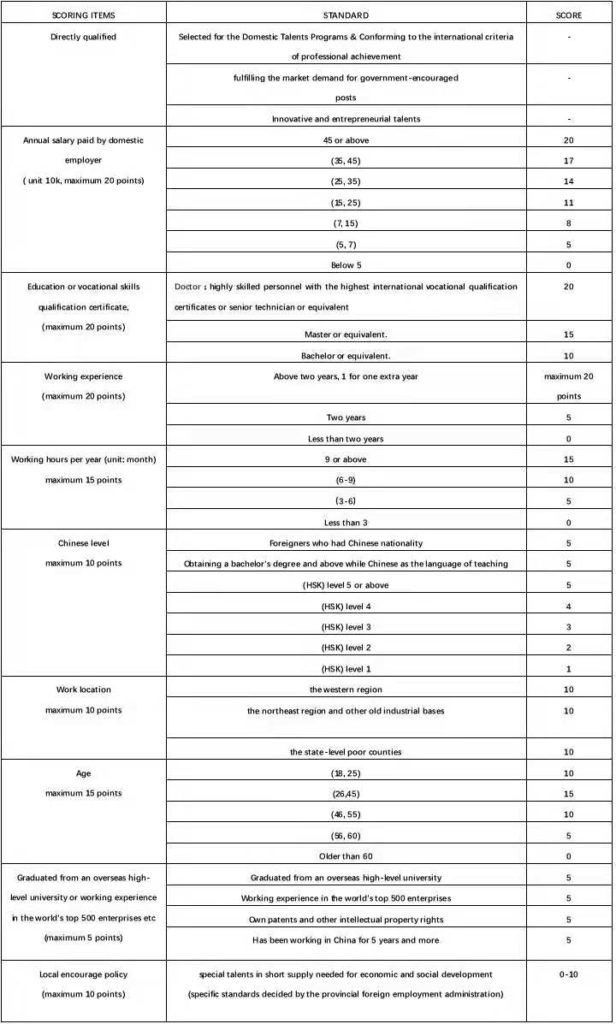
It’s a comprehensive evaluation system based on the foreigner worker’s professional achievement, income level, Education or vocational skill level, working experience and Chinese level etc.  The points is believed to be important for foreigners try to apply for a longer work permit or even green card. We translated the points-based System as below, let’s see how many points you can get?

The points-based-system of China is believed to be important for foreigners try to apply for a longer work permit or even green card.

Related link:

Ministry of Human Resources and Social Security of the People’s Republic of China

Check out Your Individual Income Tax Status in China!

On 20th of August, 2019, the National Development and Reform Commission (NDRC) promulgated the Circular about Strengthening Construction of Credit Database for Individual Income Taxpayers.

The highlights of the Circular include:

1. Establish an individual income tax credit management mechanism and implement the credit commitment system.

2. Establish and improve the income tax credit records, collect and evaluate tax and credit information according to the law.

3. Taxpayer shall be responsible for the authenticity and accuracy of their income and tax information.

4. Establish an identification mechanism of natural person’s  fraudulent activities, particular attention to will be paid to violation of relevant laws and regulations, tax evasion, tax fraud and other  fraudulent activities. Serious cases will be made public according to law, and related information will be transferred to the national credit information sharing platform, and their credit data will be updated from time to time. 

5. Individual income taxpayers with serious dishonest behaviors would be subject to joint punishment. Tax agency and relevant departments will work together to roll out joint punishment measures against taxpayers who make dishonest or false tax declarations, special additional tax deductions and tax privileges.

All expats working or doing business in China must be careful with your tax issues now, ask yourselves the following questions or check with your accountant or tax attorney about your tax status in China:

Make sure your tax status in China is very important!

1.Am I a tax payer?

Expats who have resided in China for 183 days or more cumulatively within a tax year, shall be deemed as resident individuals, all income from China and overseas shall be subject to individual income tax.

For expats who have resided in China for less than 183 days cumulatively within a tax year, shall be deemed as non-resident individuals, only income from China shall be subject to individual income tax.

2. What are taxable income?

According to the updated IIT law, the following categories are all taxable income:

1. Comprehensive income, including: wages and salaries, remuneration for personal services, revenue for manuscripts and Royalties;

2. Business operation income;

3. Interest, dividends and bonuses;

4. Income from lease of property;

5. Income from transfer of property;

6. Contingent income

Also, please remember as long as the income is from China, even the location of payment is outside of China, the income is subject to China IIT law.

Related link:

State Taxation Administration

Labor Dispute Resolution in China

In China, if mutual negotiation can’t solve a labor dispute, then related authority’s involvement will be needed for an effective solution.

 The amount of labor dispute cases has risen in China because the younger generation have more right-protection awareness.

Unlike in general civil or commercial disputes, the parties can choose the authority to solve the dispute—arbitration or lawsuit, either party to a labor dispute has to apply for a labor arbitration first instead of going to the court directly. The reason for the initial arbitration phase is to try to solve the dispute without getting the court involved, to avoid a waste of judicial resources. However, since the low cost for labor arbitration and lawsuit–either party has to pay just 10 RMB to file for it—sometimes, the party will appeal until the last phase just because they want to hold executing the result. A total waste of judicial resource and the other party’s time.

It’s required that the labor dispute be submitted to a labor arbitration commission in the district where the employer is located. The application to arbitrate must be filed within one year from the date the cause of action arises, and the arbitration panel has 60 days from the date of filing to issue a decision. The decision of the arbitration commission is binding, but a party may bring the dispute to the courts if dissatisfied with the arbitrator’s decision. And like any other civil or commercial disputes, the second instance will be the final one. So a labor dispute could be solved within three months, but it probably would take one and half years, if the whole procedure has to be gone through.

Since 2008, when the Labor Contract law and relevant arbitration laws came into effect, the amount of labor dispute cases has risen. Two main reasons are:

1. Generally, the younger generation have more right-protection awareness and are apt to use judicial resources to settle disputes.

2. The fees involved are limited. Unlike civil or commercial disputes, the majority of the burden of proof is borne by the employer, so most of the employees could do it by themselves as long as they know the related provisions. However, for employers, things are not so simple. Most of the time, they have to hire a lawyer to handle this, unless their HR staff have enough experience to take care of it.

Though most of the labor disputes filed by the employee is to defend their rights, some may be filed by some disgruntled employee hoping to get extra compensation. So the employer has to be very careful when dealing with labor disputes. The reason “the employee did something wrong” is not enough to justify the firing of an employee, the employer has to provide enough evidence to prove that:

1. The employee did something wrong is an objective conclusion instead of a subjective judgement;

2. The employer has done their job in line with the laws, such as warn or notify the employee.

It’s a little tricky, right? This is not an easy job for most HR staff of SMEs. That’s why we provide the service package “HR solution”. Anyone interested may contact us for further info.

Useful link:

Ministry of Human Resources and Social Security of the People’s Republic of China

Female employee rights in China

In our previous post, we discussed “What are the Rights of Employee in China?”, now let’s see some special rights specified for female employees.

In China, most women will work till their retirement, even after they give birth.  China labor law specifies some special provisions about the labor protection of female employees, as well as the interests and rights of a female employee.

1. Labor protection for female

Special labor protection has be specified for woman--particularly in three phases

All companies shall comply with the provisions on scope of incompatible labor work for female employees, which specifies the scope of incompatible labor work for female employees in general, as well as during the menstruation period and during pregnancy. Additionally, the company is obliged to notify the female employees of the positions in the company which fall under this scope, if any.

2. Special protection for female during pregnancy, childbirth and breastfeeding (“three phases”)

1) No company shall reduce the salary of any female employee or terminate the labor contract during the three periods;

2) When a female employee is unable to perform her original job duties during pregnancy, the company shall reduce her workload or arrange another suitable position based on the certification of the medical institution.

For a female employee who is in the third semester of pregnancy, the company shall not extend her working hours or assign night shift duties, and shall allocate a fixed resting time during working hours.

The time taken for prenatal checkups of pregnant woman during her working hours shall be included in their working hours.

3. Special treatment for females around childbirth and breastfeeding

1) The maternity allowance

during maternity leave of female employees who have bought maternity insurance shall be paid out from the maternity insurance fund based on the average monthly salary of the company’s staff for the preceding year; for those who are not covered by maternity insurance, the maternity allowance shall be paid by the company based on the female employee’s salary prior to her maternity leave.

Medical expenses for childbirth or miscarriage of female employees who have bought maternity insurance shall be paid out from the maternity insurance fund based on the items and rates stipulated by the maternity insurance; for female employees not covered by maternity insurance, the medical expenses shall be paid by the employer.

2) Female employees giving birth

shall be entitled to a maternity leave period of 98 days, of which 15 days may be taken before delivery; in the event of dystocia, the female employee shall be entitled to an additional 15 days of maternity leave; in the event of multiple births, the female employee shall be entitled to an additional 15 days of maternity leave for each additional baby.

Additionally, each province has extra maternity leave for female employees, ranging from 30 days to 60 days, depending on local regulations.

A female employee who suffers a miscarriage during the first four months of pregnancy shall be entitled to 15 days of maternity leave; a female employee who suffers a miscarriage after the fourth month of pregnancy shall be entitled to 42 days of maternity leave.

3) For female employees breastfeeding

their baby that is below one years old, the employer shall not extend their working hours or assign night shift duties.

The employer shall arrange one hour of breastfeeding time in each working day for female employees during their breastfeeding period; in the event of multiple child births, the female employee shall be entitled to one hour additional breastfeeding time for each baby.

4. Sexual Harassment

Employers shall prevent and curb sexual harassment towards female employees at work premises.

Useful link:

Ministry of Human Resources and Social Security of the People’s Republic of China

More about registered capital (part 2)

As we mentioned in our previous post: WFOE Formation in China—Simplified Now, for most industries, there is no requirement for minimum registered capital any more. So it seems funds will not be as much of a problem for most startups as a couple of years ago, but no minimum capital requirement doesn’t mean you can run a company in China with zero funds.

Practically, how much funds will be needed to maintain a company?

Prepare enough funds for your company, though there is no more requirement for minimum registered capital

1. Rent

Virtual offices are not allowed in mainland China. In most cities, business is not allowed to be done in residential property. This means you have to rent an office to run your company.

2. Bookkeeping service

Once the company is incorporated, a tax report has to be submitted to the tax authority from the first month the business license is granted (the day the business license is granted is the day the company is incorporated). Most startups will hire a part time accountant to do the bookkeeping in line with related requirements.

Another thing startups should keep in mind is that they have to submit the annual tax report and go through a joint annual compliance inspection by the end of June each year.  Otherwise, they will be put on the blacklist of the AIC, their business license will be revoked and they cannot do business any more. Usually, they will pay someone to do it.

3. Salary

For some startups, they won’t hire any employees in the beginning. However, they have at least one employee, the owner themselves. They have to apply for a work permit and residence permit as an employee of their startups. Local authorities have a stricter requirement for work permit issuance now. They are reluctant to issue work permits to people who did not pay any individual income tax.

The above mentioned costs are the minimum funds that will be needed to maintain a company in China. Of course, however, extra funds will be needed to develop the business.  There is no more minimum capital requirement from a legal perspective, but there still is from business perspective, so people need to consider all costs carefully before they start up their business.

4. Reminder:

More than once, we noticed that for the purpose of controlling costs, sometimes people will hire a local agency to help them to incorporate a company and do bookkeeping. However, they didn’t do enough homework to really know the agency, they just hired the agency because it was cheap. Afterwards, they find they got stuck somewhere, because the agency was too unprofessional. Eventually, they had to pay more fees to get it fixed, if at all possible.  In our opinion, leaving the job to professionals is actually the key to cost control in the long term.

Useful link:

State Administration for Market Regulation

Negative List for Foreign Investment –2019 Edition

On June 30th 2019, the National Development and Reform Commission and the Ministry of Commerce issued the Special Management Measures for Foreign Investment Access, also known as the “Negative List 2019 Edition”. With the number of entries reduced from forty-eight to forty, the negative list will come into effect on July 30th 2019.

Updated Negative list for foreign investment in China

The negative list controls which industries can be invested in by foreign companies. Foreign investment outside the negative list shall be managed in accordance with the principle of consistency of domestic and foreign investment. For more information related, please check the previous post: Abstract of Foreign Investment Law of PRC.

The negative list controls which industries can be invested in by foreign companies. Foreign investment outside the negative list shall be managed in accordance with the principle of consistency of domestic and foreign investment. For more information related, please check the previous post:

The 2019 edition of the negative list introduces new opening measures in a range of areas:   

1. The service industry 

In the field of transportation, the restriction that domestic shipping agents must be controlled by the Chinese side shall be lifted.     

In the area of infrastructure, the restriction that the  gas and thermal pipe networks in cities with a population of more than half a million must be controlled by the Chinese side shall be lifted.

In the field of culture, the restriction that cinemas and performance agencies must be controlled by the Chinese side shall be lifted.

In the field of value-added telecommunications, the restrictions on foreign investment in domestic multi-party communications, storage and forwarding, and call centers have been removed.   

2. The agriculture, mining and manufacturing industries

In the field of agriculture, the prohibition on foreign investment in the development of wildlife resources shall be lifted.

In the mining sector, the restrictions on oil and gas exploration and development restricted to joint ventures and cooperation shall be lifted, and the prohibition of foreign investment in tantalum, tin, palladium and fluorite exploration and usage shall be lifted as well.

In the manufacturing sector, the prohibition on foreign investment in the production of paper and ingots shall be lifted.

Generally speaking, this revision of the negative list allows foreign ownership or sole proprietorship in more areas. At the same time, Free Trade Areas will continue to play the role of a testing area for foreign investment. On the basis of the national opening measures, the negative list in the 2019 edition of the Free Trade Area has removed restrictions on foreign investment in the fields of aquaculture, fishing and publication printing, and continues to expand the “opening-up test”.

Useful link:

MINISTRY OF COMMERCE OF THE PEOPLE’S REPUBLIC OF CHINA