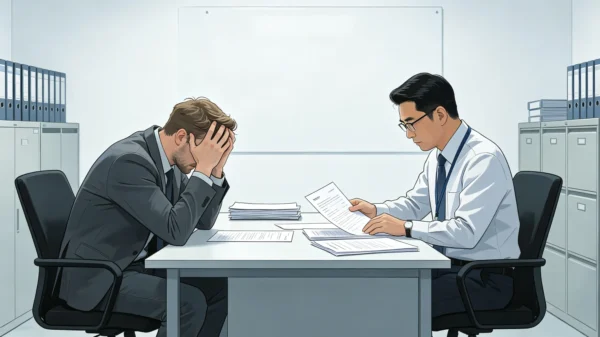
A buyer pays a factory to develop a product. It sells well. Two years later he tries to move production — and learns three things in one afternoon: the drawings live in the factory’s CAD system, the patent application carries the factory’s name, and the molds stay with the factory until “outstanding balances” clear.
None of that is bad luck. Chinese law fills every blank in your contract with the factory’s rights, and most buyers sign with a lot of blanks.
Four documents close those blanks: an NNN before you disclose anything, an ownership clause in the development contract, a mold clause in the OEM contract, and your own registrations in China. Here is what the law does when you say nothing — and what each document does instead.
When your contract is silent, the law answers for you
Five things buyers assume, and what PRC law actually says:
| What you assume | What the law says | Basis |
|---|---|---|
| “I paid for the development, so the patent is mine.” | The developer gets the patent application. | Civil Code Art. 859 |
| “The know-how is mine — I funded it.” | Both sides may use it and transfer it. | Art. 861 |
| “The design files are mine — I paid the designer.” | Copyright follows the person who created them. | Copyright Law Art. 19 |
| “I paid for the molds, so I own them.” | No rule at all. Whoever holds them, keeps them. | — |
| “My brand is safe at home.” | China registers to the first filer, not to you. | Trademark Law |
Notice the pattern. Every default moves ownership away from the party who paid and toward the party who holds the asset — the developer, the designer, the factory floor.
Why the trade-secret statute won’t rescue you
The Anti-Unfair Competition Law punishes misappropriation of confidential information (Art. 9). To win, you need three proofs: the information was secret, it had commercial value, and you took confidentiality measures. Email drawings to a factory without signing anything, and you usually fail the third proof — by which point the information is already gone.
A trade-secret suit takes years and turns on evidence you no longer control. An NNN turns on one document. In short: the statute is a fallback; the NNN is the plan.
Document 1 — the NNN, signed before the first drawing
Use an NNN, not an NDA. An NDA stops public disclosure. Chinese factories rarely publish your design — they use it, or they pass your orders to a sister company. The NNN covers both gaps: non-use and non-circumvention.
Three conditions make a Chinese court enforce it: your own lawyer drafts the Chinese text, the agreement names PRC law and a Chinese court, and each breach carries a fixed sum — a number a judge can award without re-quantifying your loss.
Clause gist: “The Receiving Party shall not disclose or use the Disclosing Party’s technical information, shall not manufacture products with it, and shall not circumvent the Disclosing Party to sell to its customers. Each breach: liquidated damages of RMB [X].”
中文要旨:不得披露、不得使用、不得绕开你直接卖给客户;每次违约固定违约金人民币【X】元。
In short: no signature, no drawings. The full logic sits in our NNN guide.
Document 2 — the development contract
One sentence does the work: everything the project creates belongs to you from the moment of creation, and the factory must file it in your name in China on request. Leave that sentence out and Art. 859 hands the patent application to the factory. You then own the goods and license the design from your own supplier.
In short: paying for development buys nothing until the contract names the owner. The clause set — and the commissioned-versus-cooperative trap — sits in the development contract guide.
Document 3 — the mold clause
No statute says the buyer who paid for tooling owns it. The factory holds the metal, so the contract decides two things: the molds stay your property regardless of who holds them, and the factory releases them within a fixed number of days on request or termination, with no lien or set-off claim over disputed balances.
In short: ownership without delivery stays theoretical, and a factory will renegotiate delivery at the worst possible moment unless the anti-lien sentence exists.
Document 4 — the registrations
- Trademark: file in China in your product classes before production starts. Your likeliest squatter is your own factory.
- Design patent: file if the look sells the product; it supports customs detention and platform takedowns.
- Patents: file what deserves one; keep the rest as technical secrets under the NNN.
- Customs: record your rights — it costs little against the exposure.
In short: contracts bind the signer; registration binds the world.
Four red flags
- The factory hands you its own bilingual draft “for efficiency” — an English translation you can read, a Chinese text you cannot. The court reads the Chinese text.
- The draft postpones IP ownership “to be discussed later.” Later means the defaults above.
- The purchase order lists a mold fee but no mold clause. Payment is not ownership.
- The factory asks for drawings “for a quick quotation” before any agreement. That request is exactly what the NNN answers.
Need help?
We advise overseas buyers on NNN agreements, development and mold clauses, and China registration as one package. If you are about to disclose a design or pay for tooling, talk to us before you sign.
Related reading
- The Vital Role of China NNN Agreements
- China Product Development Agreements: Who Owns the IP You Paid For?
- How to Write an Enforceable OEM Contract in China
- How to Pay a Chinese Supplier Without Getting Burned
- Don’t Let Your Supplier in China Hold You Hostage
Sources (accessed November 2026): Civil Code of the PRC, Arts. 585, 859, 861; Copyright Law (2020 Amendment), Art. 19; Anti-Unfair Competition Law, Art. 9; Trademark Law.
Frequently asked questions
A1: Yes. The timing rule is absolute: no drawings, no BOM, no samples, no technical factory visits before the NNN is signed. Once the information is disclosed, no later document can recover what has already leaked. And use an NNN rather than a plain NDA: the realistic risk in China is not public disclosure but the factory using your information itself or routing orders to a related company, which an NDA does not cover.
Q2: Who owns the molds in a China OEM arrangement?
A2: Whoever the contract says owns them — and if the contract is silent, no statute supplies a default, so the factory effectively wins because it physically holds the tooling. The contract should state that molds funded by the buyer remain the buyer’s exclusive property, must be marked as such, cannot be used for third-party orders, and must be delivered in serviceable condition within a fixed number of days on request or termination, without any lien or retention claim.
A3: No. China’s defaults favor the developer: under Article 859 of the Civil Code the right to apply for a patent on commissioned development belongs to the developer unless agreed otherwise; under Article 861, unagreed technical-secret results can be used by both parties; under Article 19 of the Copyright Law, copyright in commissioned work belongs to the commissioned party absent agreement. You own the IP only if the development contract expressly grants you 100% of it, from the moment of creation.
A4: Yes. China is first-to-file for trademarks, and your home registration gives no rights in China. The most common squatter of a foreign buyer’s brand is its own manufacturing partner or its staff, filing “to protect the supply chain.” Register in the classes covering your products before production starts, and consider design patents for the product’s appearance — registration is what makes customs seizure, injunctions and platform takedowns possible.
A5: Fixed liquidated damages per act of breach, in an amount the judge can award without re-quantifying it. Chinese courts may reduce amounts excessively above proven loss (Civil Code Article 585, with roughly 30% above proven loss as the working reference line), so punitive multipliers get cut. Calibrated fixed sums per violation — per disclosure, per unauthorized production run, per circumvented order — survive; vague “all damages” clauses do not.
A6: Treat it as a fallback only. Article 9 of the Anti-Unfair Competition Law prohibits misappropriation of confidential technical and business information, but you must prove the information was secret, commercially valuable, and subject to confidentiality measures — and drawings emailed without a signed instrument usually fail that test. Trade-secret litigation is slow and hard to prove; an NNN agreement enforced as a contract is faster and decided on the document.
Disclaimer: This article is general information about PRC law, not legal advice, and no attorney–client relationship is created by reading it. PRC law and local practice change frequently — confirm before relying on this content. © 2026 Chibridge Law Firm / China Law Help.