FAQs Regarding Setting Up a Company in China

Among all other issues, the most frequently asked questions we received is: “Can you set up a company for us?”

Honestly speaking, if the field you want to invest in is not in the Negative List ( you may review our post: Newly Released Negative List for more information), it’s pretty easy nowadays to set up a company in China. Although, we understand that some overseas firms always emphasize how difficult and time consuming (in other words, costly) it is to set up a company here to justify such endeavor.

However, be that as it may, setting up a company in China is still worth considering over carefully. It’s not something that you can just start doing and drop when you think you don’t need it anymore ( you may review our post: Close Your Company Properly – Don’t Just Run Away! for more information) . 

Setting up a company in China is worth considering over carefully, it’s not something you can just drop and walk away once you start it

Here are some important questions you need to ask yourself before you make the final decision:

1. What’s the purpose for setting up a company?

There may be multiple reasons to set up a company. One common reason is that their clients need fapiaos (invoice issued by local tax bureau) for the service or products they have paid for.  Then, there are some who would claim that their distributor didn’t do a good job in promoting their products; they believe a physical presentation in China is very important to do the marketing and interact with their customers directly.

Another common reason is: “ I need to apply for a work visa with this company”. Well, this is perhaps one of the worst reasons to have in setting up a company. Let me explain:

For a B type work permit, the applicant should be a bachelor degree holder with two years work experience related to the position he is applying for. If you are not qualified, then you just can’t. Even your own company can’t apply for a work permit for you.  In other words, the fact you are the investor or legal representative of the company is not a guarantee that you will get a work permit. Application for work permit has its own requirements, being the investor or legal representative doesn’t matter at all.

2. Do you have enough funds to support the company’s operation for at least one year?

You need to have the funds needed to maintain the normal operation of the company, such as, rent, utilities, salaries and service fees for service providers like book keeping, advisements etc.  In most cities, a virtual office is not allowed. It’s required that you sign an office least agreement for at least one year to proceed with the company incorporation procedure.

As to the source of the fund, it could be provided by a parent company expanding into China market, or revenue generated from your original business operation or savings.  Whatever the situation is, make sure the fund is enough to maintain a normal operation even if you don’t make any money during the initial year.  Of course, not making money during the whole first year is the worst case scenario, but operating a business under financial pressure is never a good idea.  A careful calculation after a thorough research and planning is highly recommended.

3. Do you understand the employment law? (If you are going to hire employees)

This is important so that you can start your company on the right foot and avoid labor issues in the future.

4.  Do you need a Chinese partner or not?

It may be hard to navigate the intricacies of managing a business in China so you may need a local partner. A right partner will make things easier, but sometimes cooperating with someone is not a good idea if done the wrong way.

5.  Have you registered your IP yet?

6. Have you found a good company to do the company incorporation for you?

In most cases the company that helped you with the company incorporation can also help you with the book keeping later on. Though company incorporation is a one time job, book keeping is a long-term project.  A terrible service provider will get you into tax trouble, so as we have mentioned in multiple occasion, when it comes to professional service, choose the best one instead of choosing the cheap one!

Once you are satisfied with your answers to those important questions then you are ready to make the final leap of starting your own company in China. Good luck.

FAQ About Corporate Seals in China

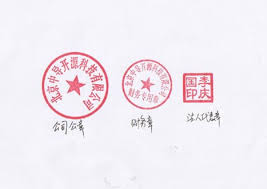
In China, the seals of a company play an important role in a company’s daily business operations. All companies are supposed to have at least three seals in total; namely, the Company Seal, the Legal Representative Seal, and the Financial Seal. These three seals are supposed to be made in a seal-making company assigned by the government. A specimen of the impression must be filed with the local Public Security Bureau during the process of a company’s incorporating procedure.

In addition, many companies also have special seals for different purposes or special seals that are applicable within different  departments of a company, such as a contract seal, an administration seal, and so on. Each seal has a different function and is applied to different specific scenarios.

All Chinese companies have at least three seals: the Company Seal, the Legal Representative Seal, and the Financial Seal
Seals of a mainland company

In our daily operation, what is important? What are we supposed to pay attention to?

Type of Seals

a) Company Seal

The Company Seal is the most powerful of all the seals of a company. It is the symbol of the company’s highest power. On an official company business-related document, (whether it is a contract, a statement or a letter of commitment), when the Company Seal is affixed, it means the content of the document is recognized by the company and the company is going to bear the corresponding legal responsibility. Generally speaking, the Company Seal can be used in all matters and occasions inside and outside the company.

b) Legal Representative Seal

There are many cases in which the Legal Representative Seal is used for a specific purpose, such as to be used together with the Financial Seal for opening the company’s basic bank account, with a specimen of the impression card reserved in the bank. When the company issues a bill, for example, it affixes the Legal Representative seal to the bill.

c) Financial Seal

Generally, a Financial Seal is used together with the legal representative seal and Financial Seal is mainly used for corporate accounting and bank settlements. When it comes to financial matters, a Financial Seal is generally required.

d) Contract Seal

The Contract Seal is intended for use when entering into contracts with other parties. However, not all companies use Contract Seals, they just affix the Company Seals when they are to sign any contracts.

e) Department-Specific Seal

In addition to the above-mentioned seals, some companies, especially larger ones, frequently use Department-Specific Seals, such as Procurement Seals, Administrative Seals, etc. These seals are usually only applicable for use inside the company, without any external effectiveness.

During our daily operations, we should pay attention to the following issues:

a) Management of the Seals

Companies shall make strict management rules over the use of seals, to avoid any potential risks. For example, the Financial Seal and the Legal Representative Seal shall not be held by the same person. Do not affix the Seals to any blank paper or document.

It is important to understand that, even if a person has signed a contract with the Company Seal affixed to it, yet is without legitimate authorization, the company is still required to bear the corresponding responsibilities. After all, it is difficult to ask any third party to check whether the affixation of the Company Seal is duly authorized . The company has the responsibility and duty to manage its own Seals.

b) Signature or Seal?

In China, the company has to affix its Company Seal or Contract Seal to the contract to make sure the contract is binding.

The signature of a shareholder, director or legal representative is usually not legally binding. This is different from what is done in many other jurisdictions and should be kept in mind.

In addition, whether the Legal Representative Seal is “chopped” or whether there is a legal representative’s signature affixed, there is no effect on the validity of the contract, unless there is a clause in the contract expressly saying that both the Company Seal and the Legal Representative Seal must be affixed for the contract to come into force.

c) Is it the correct seal?

This question is especially important for many overseas companies. The Company Seal is written with Chinese characters, thus it can be difficult to identify it. However, from the shape of the Company Seal, we can also make a judgment. As a matter of fact, from time to time, we receive emails from international buyers asking for help, claiming that they have not received goods after having made payments to trading companies. However, after reviewing their contracts, we found that they were actually dealing with a so-called “Hong Kong Company,” and it is not uncommon for Hong Kong Companies to be incorporated for the purpose of perpetrating fraud. ( You may check our post: The Top Five Things You’ll Need to Do While Purchasing PPE for more information )

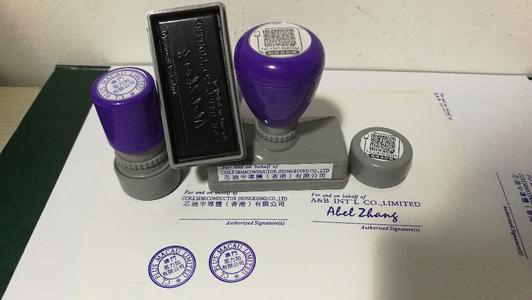
Seals of a HK company

Generally speaking, a Hong Kong Company has three Company Seals and one Common Seal.  These three Company Seals are: one small round seal, one authorized signature seal and one oval seal. The color of the stamps are blue or purple.

Of course, if one is sure that the other party is a mainland company, it should have affixed their Company Seal or Contract Seal. Any other seals are not acceptable for a contract to come into effect

FAQs about Patent Applications in China

We mentioned in more than one of our previous articles that you need to register your trademark in China ASAP, as China is a “first to file” country (you may check :How to Get Back My Trademark in China? for more information). Then here comes the question: what about patent registrations? Does China apply a “first to file” principle in patent registrations, too?

Yes, the first to file principle also applies to patent registrations. More than that, as patent means something novel, something that has not been disclosed to the public anywhere in the world, it means the timing for filing the application is very important. Now, we are going to share our tips with regards to registration of a patent particularly today.

1. Submitting your patent application simultaneously around the world

Unlike a trademark registration, if any identical or similar trademarks have been applied or registered previously, your application will not be granted.  The most important thing about a patent registration is that it has to be something that has not yet been disclosed to the public before you file for a patent.

Disclosed to public, not only means that you have already sold it and exposed it by advertising, but also exposed it by applying for a patent in any other country in the world.

Yes, you get me correctly, applying for a patent is also a kind of exposure. However, according to Article 29 of Patent law of the PRC: “Where, within twelve months from the date on which any applicant first filed in a foreign country an application for a patent for invention or utility model, or within six months from the date on which any applicant first filed in a foreign country an application for a patent for design, he or it files in China an application for a patent for the same subject matter, he or it may, in accordance with any agreement concluded between the said foreign country and China, or in accordance with any international treaty to which both countries are party, or on the basis of the principle of mutual recognition of the right of priority, enjoy a right of priority.” So, if you have ever filed a patent application in any other country, you should file for it in China before this six or twelve months elapse.

Then what if you missed the deadline?  We understand that there is no substantial examination for a design patent and utility model patent application, so if you apply for these two patents in China after the deadline and claimed that you never did any previous application outside of China, you probably might get your application granted. However, if your previous application in other countries has been reported to the patent office by any of your competitors, your patent will be invalidated right away.

The most important thing about a patent registration is that it has to be something that has not yet been disclosed to the public

The following are our step-by-step tips:

1) Making a list

While still working on your patent, you had better figure out the plan for future protection. Make a list of the jurisdictions in which you think you want to be protected, for example, you either want to outsource the manufacture of your product in China, or want to sell your product in China someday, it’s highly recommended to include China in the list.

2) Finding the suitable patent lawyers

Once the list is made up, talking to your lawyer who helps you handle the patent application. Ask if he/she know any lawyer in those jurisdictions, as most lawyers probably have connections in other countries more or less. Anyway, try to find lawyers in all jurisdictions and talk with them until you are sure that they can help you.

Please understand different countries have different requirements over the paperwork for patent application even if the product is actually the same, and it takes time to understand the exact requirements and have proper paperwork to be prepared. That’s why we suggest you reach out to find the suitable lawyer first, before you start your application in any country.

3) Start the application at the same time

Once you complete step 1 and step 2, all you have to do now is to start the application procedure at the same time once you are ready for a patent application.

2. Type of patents in China

The Chinese IPR protection system has been developed in the recent 30 years, which of course, is built on international practice.  But still there is something unique. Understanding this kind of uniqueness and the differences from other legal system will help us to understand how to do a better job in protecting your IPRs in China.

According to the Patent law of the PRC, there are three kind of patens in China: design, utility model and invention.

1) Design

Design is defined as the shape, pattern, or the combination thereof, as well as the combination of color with shape and pattern which is aesthetically appealing and suitable for industrial applications.  The main difference between a design and invention or utility model is that design focuses on the artistic and aesthetic creation over the exterior appearance of a product. However, it is not a simple handicraft, it must have the practicality that can be applied on an industrial basis.

The protection object of a design patent is the product’s decorative or artistic appearance, which can be a flat pattern, or a three-dimensional model, actually more common, the combination thereof.

2) Utility model

Utility models are new, practical technical solutions regarding to the shape, construction, or combination thereof of a product. Like inventions, utility models protect a technical solution. However, the scope of protection of utility model is narrow, it only protects new product with a certain shape or structure, can’t protect methods and substances without fixed shapes. Compared to inventions, utility models focus more on practicality, while its technical level is comparatively lower. In most countries, utility model patent will be granted to relatively simple, or improved technology inventions, which is usually called “small inventions.”

Substantive examination is not needed for granting of a utility model patent, thus the application procedure is relatively simple, and the cost is low. For small inventions on tangible products, such as daily necessities, machinery, electrical appliances etc., application for utility model patents is more suitable.

3) Invention

An invention is a new technological solution proposed for a product, method or improvement, which can be a product invention or a method invention. Method invention includes all methods of using the laws of nature, and can be divided into manufacturing methods and operational methods, such as the invention of processing methods, manufacturing methods, test methods or product use methods.

An invention patent can be granted to a solution of method or a solution of software, which does not reflect a change in shape or structure of a product, while a utility model patent can only be granted to change in shape and structure. The most important thing is, compared with all existing technology, inventions must have outstanding substantive features and significant progress.

4)Differences

Design patents are essentially designed to protect artistic ideas, while invention patents and utility model patents protect technical ideas. Though both designs and utility model are related to the shape of a product, the purpose of these two patents is different. Design is to ensure the product to be aesthetic, while utility model is intended to enable a product to solve a technical problem.

For example, if the shape, pattern and color of a table lamp is quite beautiful, then a design patent should be applied for. If the design (particularly the structure) of the table lamp is streamlined and reasonable, for example, save materials or more durable, then a utility model should be applied for. In another words, design focus on how the table lamp looks, utility model focus on how the table lamp functions.

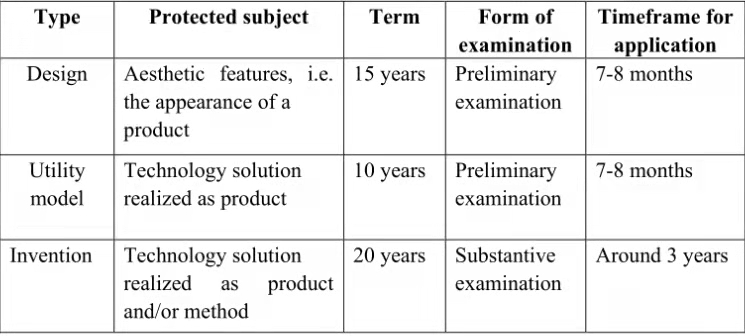
Again, the example of a lamp, it’s Edison who invented the electrical lamp. What he provided, is a creative technological solution which brings light to the world, which is called an invention. Based on his invention, stable lamp, floor lamp etc. are all utilities. You may check the following chart for the main differences:

The most important thing about a patent registration is that it has to be something that has not yet been disclosed to the public

3. Tips for patent applications

1) Finding a suitable agent

All overseas company or individuals need to hire a local agent to submit their application for patent to the State Intellectual Property Offices (SIPO) and all application material must be in Chinese.

As in almost all service sectors in China, the difference in service fee for patent application is sometimes exaggerated.  Though high fees don’t mean a high level of service, but low fees are always related to a low level of service. You have to make sure the agent includes all points you want to have protected in your application, so this agent needs to understand your intention thoroughly and then expresses your intention accurately in a way up to the examiner’s requirements.

The more experienced an agent is, the better he understands the requirement (no matter it’s something on paper or something between the lines), thus the more expensive the fee. When choosing the professional service provider, comparing the fee level instead of focus on the level of service is really not a smart move for all business, the same reason has been explained thoroughly in one of our post:  Why A Good Accountant Is So Important

2)Term and maintaining fees

After the patent has been granted, the patent holder needs to pay annual fees in time to maintain the validation of the patent, otherwise, the patent will be invalidated six months later. Of course, your agent is supposed to remind you of the payment in time.

In China, the term for a utility model is 10 years, for a patent is 20 years. According to the newly amended patent Law of the PRC, the term for a design is extended to 15 years. All terms can’t be renewed.

Minimum Wage Standards in China

Q1. Why are there different grades for the minimum wage standard?

As shown in the chart below, the minimum wage varies from place to place and is graded. The minimum wage is graded according to the level of the local economy in each province. For example, the first-level minimum wage is applied to provincial capital cities, the fifth level minimum wage is applied to fifth-tier cities.

Q2. How is the minimum wage adjusted?

In accordance with the minimum wage provisions and the relevant policies of the Social Security Bureau, the minimum wage can be adjusted every two years in each province depending on the local economy of the province. The adjusted minimum wage shall not be lower than the pre-adjustment minimum wage.

Q3. How is the minimum wage calculated?

According to the relevant provisions of the minimum wage regulation, the minimum wage is calculated in two ways, which is the monthly wage for full-time workers and the hourly wage for part-time workers. There are different methods of calculation according to the type of employment and the requirements for respective positions.

Q4. Is the “Social insurance and housing provident fund” included in the minimum wage?

In general, the “social insurance and housing provident fund ” is included in the minimum wage, which means, the expenses that employees incur to pay social insurance and their contributions to the provident funds are part of the minimum wage and are paid by the employer on behalf of the employees in the name of the employer (you may read our blog: More on Social Insurance for more information). However, the policies in some regions, such as Beijing and Shanghai, clearly indicate that the “Social insurance and housing provident fund” do not fall within the scope of the minimum wage.

Filing a Trademark Application in China

Each time, when we talk about trademark protection in China, we suggest: “File your trademark application ASAP!”

With that being said, there are some preliminary things you need to do before you eventually file your trademark. A thorough research has to be undertaken to understand what kind of text/graphic can be registered as a trademark in line with the Trademark Law of the PRC, already before you have the logo designed or consider a logo officially and initiate your marketing campaign. The following tips might be valuable:

I. The text must not be forbidden by law.

1. It must not be identical or similar to the name, flag, sign, emblem, military flag or the like of any country or international organizations, such as the “Red Cross” or “Red Crescent”.

The below-mentioned country name includes the full name, references and abbreviations and acronyms. For example, the official name of China is the People’s Republic of China. And the abbreviation or acronym is “CHN”, “P.R.C.”, “China”, “PR OF China” or “P.R. CHINA”.

However, there are still some exceptions allowed if the text is approved by the government of the country concerned. For the purpose of applying this exception, an applicant shall submit a written proof of the consent of the government of the country concerned. Where the applicant has registered such a trademark in the foreign country concerned for identical or similar goods or services, it shall be deemed as the consent of the government of the foreign country concerned.

2. It must not be identical or similar to official signs or hallmarks indicating control or warranty, meaning the signs or hallmarks used by official authorities to indicate their control, warranty or inspection over the quality, performance, ingredients or raw materials of the goods, such as CE certification, or FDA certification etc.

3. It must not contain discriminatory or offensive content.

4. It must not consist of exaggerated and fraudulent advertising, which is deceptive and likely to mislead the public with regards to the quality, trait, main raw material, ingredients or other features or places of origin of relevant goods etc. Such as use “24k” or “100% purity” to refer to any gold jewelry, to use “organic” to refer to any agricultural products, or use “Good Pork” to refer to vegetarian diet etc.

5. It must not mislead the public with regards to the place of origin or source of relevant goods or services. If the marks are composed of well-known foreign geographical name(s) or contain geographical name(s), while the applicant of which is not from such place, such applications will be rejected by the trademark office.

II. The text has to be distinctive

Distinctive features of a trademark refer to those features which a trademark shall have and are sufficient to enable the public to distinguish the source of goods, after all, this is the main purpose of any trademark – distinguish instead of confusing the public.

When judging whether a trademark has distinctive features or not, the following elements shall be considered: meaning, appellation and appearance or composition of the mark constituting the trademark, the designated goods of the trademark, the recognition habits of the public with regards to the designated goods of the trademark, the actual use in the industry of the designated goods of the trademark, etc.

Here are some examples were trademarks may not be distinctive enough:

1. Marks only having generic names of designated goods. Thus, we can use “apple” to refer to any manufactured product, however, we can’t use “apple” to refer to any kind of as fruit.  

2. Marks only having direct representation of the quality of designated goods, such as using “yummy” or “delicious” to refer to any food.

3. Marks only having direct representation of technical features of goods, for example, use “Bluetooth” to refer to a telephone or laptop.

4. Marks only having direct representation of the function or use of designated goods

such as displaying the text “purified gas” to a designed product “Gas Purification Device”

5. Marks only having direct representation of the main raw materials of designated goods, such as the use of “colorful cotton” to refer to clothing.

Trademark application is not merely submitting the application, expertise and experience should be the key factor in choosing the agent

6. Those that otherwise lack distinctive features, such as simple lines, general geometric figures, over-complicated words, patterns, numbers, letters or combination thereof, for example, a marketing post (combination of words, drawings).

7. One or two letters in general expressions, Arabic numerals in common form or ordinary packing or containers. However, if these letters, Arabic numerals, packing or containers are combined with other elements and leave a unique impression with the public then a trademark may be granted.

III. The mark must not be identical or similar to previous trademarks of others.

Identity of trademarks means that both trademarks are basically and visually the same and will likely confuse the public with regard to the source of goods or services when being used on the same or similar goods or services.

Similarity of trademarks means that trademarks are similar in font, pronunciation or meaning, or the overall arrangement and combination method or appearance of the combination of words and graphics in case of word trademark, or similar in shape or appearance in case of three-dimensional trademarks, or similar in color or color combination in case of color trademark, or similar in auditory perception or overall music image in case of a sound trademark, and will confuse the public with regards to the source of goods or services when being used on the same or similar goods or services. Identical goods or services include goods or services of the same name and of different names but referring to the same goods or services.

In conclusion, a trademark application is not just a simple task of merely submitting the application. Expertise and experience should be the key factor in choosing a professional service provider to help our readers with their trademark applications.

Useful link:

Trademark Office of National Intellectual Property Administration, PRC

Hot off the press! Provisions on the Unreliable Entity List

On 9 September 2020, China’s Ministry of Commerce released Provisions on the Unreliable Entity List, which take immediate effect upon their release.

the mechanism can decide to take one/multiple measures against foreign entities on the unreliable entity list, and make a public announcement

According to the regulation, the work mechanism can decide to take one or multiple measures against foreign entities on the unreliable entity list, and make a public announcement:

1. Restrict or ban its China-related import & export activities;
2. Restrict or ban its investment in China;
3. Restrict or ban the entry into China of its staff or transport facilities;
4. Restrict or revoke its staff’s work permits, stay or residential qualifications in China;
5. Impose penalties according to the severity of its unlawful activities;
6. Other necessary measures.

Since 31 May 2019, when the Ministry of Commerce first announced the establishment of an “unreliable entity inventory system”, the so-called Chinese version of the “entity list system” has attracted widespread attention from Chinese and foreign companies.

In an interview with journalists on 1 June 2019, an official from the Ministry of Commerce said that the Chinese government will take into account four factors, when it decides whether to include an entity on the “list of unreliable entities”:

First, whether the entity has imposed a blockade, cut off supply or other discriminatory measures against the Chinese entity;
Second, whether the entity’s behavior is based on non-commercial purposes, contrary to market rules and the spirit of contract;
Third, whether the entity’s behavior has caused substantial damage to Chinese enterprises or related industries;
Fourth, whether the entity’s conduct poses a threat to national security or a potential threat.

It looks like the final provisions have made changes in two aspects: one is to highlight the “national sovereignty, security and development interests”. The other one is, adding to consider whether it is in accordance with international business and trade rules.

For more information please visit the website of MINISTRY OF COMMERCE OF THE PEOPLE’S REPUBLIC OF CHINA

Benefits of Copyright Registration

Unlike other IPRs, a registration with the competent authority is necessary to obtain any protection in China, even if a copyright comes into being automatically. It means that the right exists once the creative work is finished and is entitled to be protected by the law without further procedures to be undertaken. So, what’s the point of copyright registration?

1. Valuable evidence of ownership

The reason is simple. Despite the fact that copyright generates naturally, the evidence of ownership of the copyright doesn’t generate itself automatically. However, for any administration, civil or criminal enforcement of the copyright to be initiated, the evidence of ownership is a preliminary condition. It’s not practical to show the competent authority a heap of original manuscripts on your laptop etc. A simple presentation of the certificate of copyright registration will save you a lot of time and trouble.

copyright registration will save you a lot of time and trouble, if you want to enforce your rights in civil or administrative procedures

2. Registration helps protect other IPRs

Moreover, registration of copyright is a supplementary tool to protect other types of IPRs, such as design patents and trademarks.

3. Longer protection period

Another benefit of copyright registration is: once the registration is finished, no extra fee will be needed to maintain its validity. The period of protection for the moral right of publication and economic rights, meaning the right to exploit the work for economic gain, is usually 50 years (if the right holder is an institution) or lifetime of the author plus 50 years. While, a design patent has a limited term of 10 years and a renewal fee has to be paid once every ten years for a trademark.

4. Scope of protection

Technically, most creative works are protectable in China, including traditional ones, such as films, paintings, books, music etc., and others, such as a database, choreography, computer software, APPs for smart phones etc. The prerequisite for a work to be protected by copyright law is that it has to be original and reproducible in one way or another.

5. Shorter and easier registration procedure

Any individual or entity can register their copyrights via the official website of the Copyright Protection Centre of China (CPCC). If the applicants don’t have  premises in China, then they need to hire an agent to do that. Once all required documents are submitted and the official fee, depending on the type of the work, has been paid, the certificate of registration will be granted within 2 months.

CHATEAU LAFITE ROTHSCHILD Won this Unfair Competition Case

Shenzhen Jinhongde Trading Co., Ltd. (hereinafter “defendant”) was found having used “LAFITE FAMILY”, the imitation logo and “拉菲世族” (Chinese translation of “LAFITE FAMILY”)on various occasions without any authorization at all. In September 2010, CHATEAU LAFITE ROTHSCHILD (hereinafter “plaintiff”) filed a lawsuit with the Changsha Intermediate Court (the court of first instance) on the grounds that the defendant violated the plaintiff’s exclusive trademark rights and engaged in unfair competition.

All overseas companies should apply for their trademarks in Chinese once they are intended to offer goods or services in China

Eventually, the final judgement was made by the Hunan High Court (appellate court) on 17 October 2011, finding that the defendant’s use of “LAFITE FAMILY”, imitation logo and the use of the domain name “LAFITEfamily.com” which contained the text of the trademark “LAFITE” on its website constituted trademark infringement. Furthermore, the defendant’s misleading promotion of its brand name “拉菲世族” on the website and other marketing material constituted unfair competition.

This lawsuit is the first intellectual property case filed by the plaintiff in China. The trial and the final outcome of this case had attracted a lot of attention given the fact that it involved a series of legal issues, such as whether the brand name “拉菲” is protectable and how it could be protected. The opinion from both courts at two levels confirming that after long-term use and extensive publicity, the unregistered brand name “拉菲” of the plaintiff has constituted the specific name of a well-known product is the highlight of the case.

From this perspective, we are sharing here our analyzes of this case:

I. “拉菲” has actually be used to refer to the plaintiff’s wine.

The use of “拉菲” in the media and its widespread dissemination have led consumers to associate “拉菲” with the plaintiff’s wine. However, whether this “association” can be converted into an actionable right depends on whether the right owner confirms this kind of “association” or not. As a matter of fact, some foreign brands are opposed to using certain Chinese names to refer to their brands or products in the media, and therefore have never actually used them. In that case, the “association” arising from the media coverage would not constitute a legitimate right.

For example, Pfizer from the U.S. uses the trademark “万艾可” (Chinese trademark of VIAGRA)on a medicine they made specifically for men with erectile dysfunction, however nearly Chinese media has been using “伟哥” referring to ” VIAGRA ” since 1998. In response, Pfizer issued a “lawyer’s statement”, specifically affirmed that the corresponding Chinese name of “Viagra” is “万艾可” instead of “伟哥”. In practice, Pfizer has never used “伟哥” on VIAGRA in China. Therefore, 伟哥 cannot be recognized as the specific name of a well-known product under Article 5 (2) of the <Anti-Unfair Competition Law>.

However, this case is totally different from the above-mentioned example.  The extensive usage of “拉菲” in referring to wine provided by the plaintiff in the media, plus the fact that the plaintiff’s usage of “拉菲” in commercial occasions, makes it a reasonable decision to assume “拉菲” as the specific name of a well-known product of the plaintiff.

II. Criteria for the protection of specific name of a well-known product

However, it should be noted that after all, the plaintiff didn’t register “拉菲”as a trademark of its wine in China. So, the legal base for the plaintiff to demand protection is the provision regarding the specific name of a well-known product under the <Anti-Unfair Competition Law> and the relevant judicial interpretation, rather than the <Trademark Law>. The key point to judge is if there exists any infringement of the “specific name of a well-known product” and to consider whether the alleged infringer did it on purpose, or with maliciousness, while the intention of the alleged infringer is something does not need to be considered in any trademark infringement case. Obviously, compared to the exclusive rights provided in the <Trademark Law>, there are more restrictions to demand protection over the specific name of a well-known product, and once again, that’s why we repeatedly tell all overseas companies to apply for their trademarks in Chinese once they are intended to offer goods or services in China. (You may visit our previous posts: Two Ways of Trademark Registration in China.

Now let’s get back to this case. It’s obvious that none of the behaviors of the defendant do not amount to an imitation of the plaintiff’s product. For example, the use of the text “LAFITE FAMILY”, the use of the five-arrow graphics in its imitation logo, the use of “拉菲世族” and the make-up story of the “拉菲世族” based on the plaintiff’s background information. The above-mentioned behaviors may be attributed respectively to the infringement of the right to exclusive use of registered trademarks, infringement of a specific name of a well-known product, false publicity, but all these behaviors are not isolated from each other, on the contrary, they constitute a systematical infringement. Thus, taking into account the fact that the defendant violated the principle of good faith with obvious maliciousness, it’s absolutely correct to assume that the defendant’s behaviors constitute unfair competition and should be dealt with accordingly.

Useful link:

The Supreme People’s Court of The People’s Republic of China