Updated Materinty Leave & Paternity Leave

China released a decision on improving birth policies to promote long-term and balanced population development in July 2021, allowing a couple to have three children.

Following the decision, authorities have adopted a number of measures, including providing maternity insurance for the third child’s birth, and easing the burden of excessive homework and off-campus tutoring for students in compulsory education.

New mothers can have an additional maternity leave ranging from 30 days to 90 days in general in 25 Chinese provincial-level regions, which have completed revising their population and family planning regulations, according to an official with the National Health Commission.

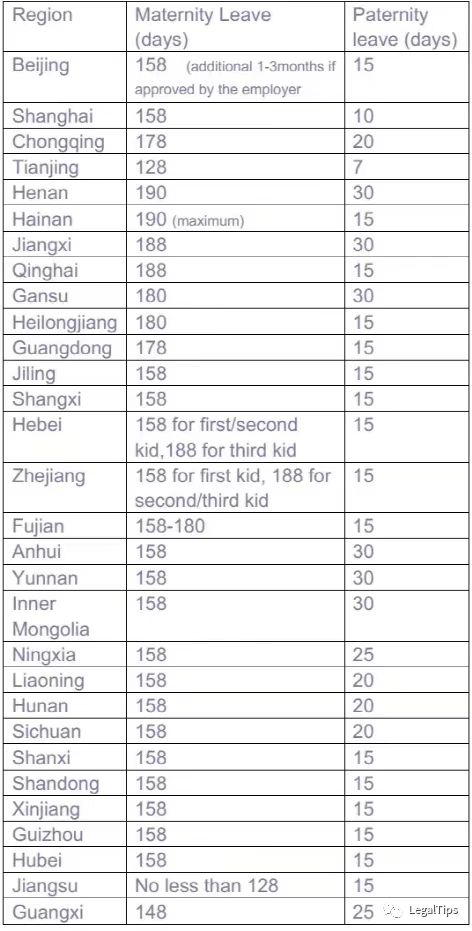
According to the updated national and local family planning regulations, we compiled the following chart of materinty leave & paternity leave for your reference:

(For more related information, you may check our previous post: Female employee rights in China)

Female employees giving birth shall be entitled to a maternity leave of 98 days, plus a 30-90 days additional leave, up to the local policy

Related provisions:

Special Provisions on Labour Protection for Female Employees

Article 7:

Female employees giving birth shall be entitled to a maternity leave of 98 days, of which 15 days may be taken before delivery; in the event of dystocia, the female employee shall be entitled to an additional 15 days; in the event of multiple births, the female employee shall be entitled to an additional 15 days for each additional baby.

A female employee who suffers a miscarriage during the first four months of pregnancy shall be entitled to 15 days of maternity leave; a female employee who suffers a miscarriage after the fourth month of pregnancy shall be entitled to 42 days of maternity leave.

Family Planning Law

Article 25: Couples that give birth to children in compliance with the provisions of laws and regulations may be entitled to rewards of extended maternity leave or other benefits.

Can She Retract Her Resignation After She Discovered Her Pregnancy?

On the morning of September 9th, 2022, Amy sent an email to her supervisor stating that she could no longer continue working for the company due to personal reasons and requested to resign with her last day being October 31st, 2022.

Her supervisor agreed to her resignation later that afternoon and confirmed that her last day of work would indeed be on October 31st, 2022.

On October 15th, Amy discovered she was pregnant and sent an email to her supervisor the next day, stating that she wanted to withdraw her resignation request and continue working for the company due to her pregnancy.

On October 18th, the company’s HR Manager replied to Amy, informing her that the company had already agreed to her resignation request, and the resignation process had already begun. In addition, due to Amy’s resignation, the company had to rearrange its business operations. Therefore, the company could not accept her request to retract her resignation.

Chinese laws stipulate that the employer may not terminate the employment of female employees during pregnancy, unless she wanted to quit

Unhappy with the company’s response, Amy filed for labor arbitration, claiming that the company had illegally terminated her employment and demanding that her employment be restored. However, the labor arbitration commission rejected all of Amy’s arbitration requests.

Obviously, Amy was dissatisfied with the decision, she filed a lawsuit, arguing that the company’s actions had harmed her legal rights, preventing her from claiming reimbursement for maternity medical expenses, maternity allowances, and maternity pay.

After hearing the case, the court of first instance found that the dispute in question was whether the company had illegally terminated the employment contract with Amy.

A. On whether the act of Amy withdrawing her resignation request was legally effective:

The court found that when Amy submitted her resignation request, the company had replied and agreed to her resignation. Therefore, the two parties had reached a mutual agreement regarding Amy’s resignation, and the process did not involve fraud, coercion, or any action that took advantage of Amy’s situation.

Additionally, Amy’s resignation request did not fall under the category of significant misunderstandings, and she had made her statement as a person with full legal capacity, so her actions were not legally revocable. Therefore, the court ruled that the actions of both parties were genuine and valid, and they must be fulfilled accordingly.

B. On the question whether or not the company had illegally terminated Amy’s employment contract:

Although the law generally stipulates that companies may not terminate employment contracts with female employees during their pregnancy (for more related information, please check our previous post: Female employee rights in China), it does not prohibit the termination of the employment contract if both parties reach an agreement. Moreover, in this case, it was Amy who had proposed to resign.

In summary, the court of first instance ruled that when Amy applied for resignation, she was not aware of her pregnancy and did not fall into the category of major misunderstanding and rejected all of Amy’s claims.

Amy appealed, claiming that as a pregnant woman, she is entitled to special legal protection; she has the right to decide to continue performing the employment contract; and the company has no right to refuse.

After the trial, the court of second instance supported the judgment of the court of first instance. They believed that relevant laws and regulations stipulate that the employer may not terminate the employment contract of female employees during pregnancy, but the law does not stipulate that the employer cannot terminate the labor contract after the female employee proposes to terminate the labor contract.

In this case, Amy proposed to terminate the labor contract to the company, and the company also agreed, thus the intention of Amy to terminate the labor contract has legal effect. Even though Amy later discovered her pregnancy, it cannot change the fact that both parties have agreed to terminate the labor contract through negotiation, so Amy’s claim has no legal basis and is not supported by the court.

Therefore, the court of second instance rejected the appeal and upheld the original judgment.

Related provisions:

Article 36 of Labor Contract Law of the PRC :

“An employer and a worker may discharge the labor contract upon unanimity through consultation.”

Article 147 of Civil Code of the PRC :

“For a civil juristic act that is performed based on a substantial misunderstanding, the person performing such act has the right to request a people’s court or an arbitral institution to revoke such act.”

Useful link:

Ministry of Human Resources and Social Security of the People’s Republic of China

What Can I Do If Living Next to a Noisy Neighbor?

Living next to a noisy neighbor can be a frustrating and a stressful experience. What is the best solution to solve this problem?
What does the PRC law say?

Here are the main points you can use to address the problem and find a solution.

A. Relevant laws & regulations

Generally speaking, noise refers to the phenomenon that noise generated exceeds the environmental noise emission standards stipulated by the state and interferes with people’s normal life.

According to the “Sound Environment Quality Standard” that came into effect on October 1, 2008, in residential areas, the noise limit standard is: 55 decibels during the day and 45 decibels at night. If this standard is exceeded, then this is classified as noise.

Noise emissions is an obvious tort that infringes on the neighboring rights of people. Neighboring rights refer to the right of either party to require the convenience or certain restrictions of the other neighboring parties, in order to reasonably exercise their ownership or use rights to their real estate.  

Article 90 of The PRC’s Property Law stipulates that:

People shall not make noise that will interfere, distract the normal life of neighboring parties, or harm the physical or mental health of others.

B. solutions

1. The most preferred way to deal with such disputes is to settle them through friendly negotiation, such as negotiate with the neighbor directly or do it through the mediation of a third parties, such as the property manager company, relatives/friends of both parties.

2. If friendly negotiation fails, it can only be resolved through legal means.

1) Call the police. According to the provisions of Article 58 of the “Public Security Administration Punishment Law”, Usually, for the situation of a noise, a warning shall be given; those who fail to make corrections after warning shall be fined between 200 and 500 yuan.

2) File a lawsuit with the court, requesting the other party to stop the infringement and compensate for losses (if any).

People shall not make noise that will interfere, distract the normal life of neighboring parties, or harm the physical or mental health of others

C. Evidence preparation

Evidence is required for filing a lawsuit, then how to prepare the evidence?

1. Prove the existence of noise: it is difficult to be accepted by the court as legal evidence by recording the noise with your own smart phone. You are supposed to hire a qualified third-party environmental monitoring agency to do that as they have professional instruments to collect and analyze noise information.

2. Prove that the noise is made by a neighbor. For example, a recording of the previous negotiation between you and your neighbor, or you may ask the property manager to provide a written statement about what happened.

3. If you believe that you have suffered any loss because of the noise and plan to claim compensation, you need to prove that there is a direct causal relationship between your loss and the noise (meaning a direct causal relationship between the damage result and the tort, such as the noise caused mental illness, for which you have paid medical expenses, etc.).

The evidence discussed in the above three paragraphs constitute a chain of evidence. It’s probably not possible to file/win the case if any evidence is missing. You may review our previous article for more: How to File a Lawsuit in China (P2-evidence)

D. Friendly negotiation

Finally, we would like to point out that, despite the many provisions, it is highly recommended to resolve the dispute amicably through consultation. The reason is as follows:

First of all, this kind of litigation is not easy to file/win, as the job of evidence collection is time-consuming, laborious and costly. Moreover, generally speaking, there is neither direct economic loss nor substantial physical injury involved, despite the fact that the noise is killing. According to the current laws, even if the lawsuit is won, the only result is the noise will be stopped. The other party does not have to pay any substantial responsible for his annoying behavior.


Relevant regulations:

Law of the People’s Republic of China on Administrative Penalties for Public Security

Article 58. A person who, in violation of the provisions of the law on prevention and control of pollution by the noise emitted in the course of social activities, makes noise to impair the daily life of another person shall be given a warning; and if he fails to make amends after the warning, he shall be fined not less than 200 yuan but not more than 500 yuan.

How well do you know about your supplier?

Despite many factors, there are many businesses buying from China. Some of them always try their best to find the “cheapest” products as far as they can, however they forget the most important point which is due diligence. In the end, they found themselves having paid for the “cheapest” products, but sometimes with extra problems.

Actually, the fee for due diligence is not so expensive, why not hire a professional to do it for you, to avoid some possible big problem?

From our experience, there are generally three issues for a standard due diligence can help to answer:

1. If the supplier is legally incorporated in mainland China?

However, a company incorporated in mainland China, is different. ( You may check our post: What Can We Learn from a Business License? to know more.)

From all the inquiries we receive asking for assistance, the largest is for helping to get their money back while more than 80% of the clients have found the businesses they are dealing with involve fraud. It’s true, they are companies incorporated in Hongkong, but the purpose for them opening the company is for fraud instead of business. The reason for them to set up a company in HK is that they can open a business in HK with little liability with zero assets. Even if the person has a business in China but opens a company in HK they are 2 separate operations and the Chinese business is not liable for the HK company.

Firstly, virtual office is not allowed, the investors need to rent an office to set up the company, few frauds are willing to do so, as the cost involved is comparatively high.

Secondly, any defendants who refuse to enforce the judgement will be put on a blacklist, which is nationwide (in mainland China, of course).

Thirdly, if the company is a factory, then they can have assets under the company’s name, usually they are real businessmen and don’t want to get involved in any litigations

2. If the company a trade company or a manufacturer?

As analyzed previously, a factory/manufacturer has assets under their name, while a trade company probably has nothing at all. On the other hand, usually you will get a better price directly from a factory/manufacturer.

Cost control should not be the excuse for not doing due diligence, otherwise extra price will be paid eventually!

3. If the company in good standing?

In China we have some paid databases which are useful for finding out more information on the company.  Such as, is there any company relevant to this company? Is this company in any litigation? For what cause? Is the company a defendant or a plaintiff? Is there any record stating that the company refusing to enforce the judgement? Does the company ever been ordered to pay fine by the government? Etc.

If you want to avoid any potential risk, it’s highly recommended to do a due diligence before you make the payment! All you have to do is to contact us!

How Can I Send My Salary Paid in China Home?

From time to time, we got inquiries from our subscribers: “Is it true that there is a cap for the salary I earned to be sent to my home country?” Or “Can I only send 50K USD each year out of China?”

Well, I assume there is some misunderstanding here.

The so-called cap of “50K USD a year” is only applied to Chinese citizens. It means the total amount for each Chinese individual purchasing/selling foreign exchange is 50K USD each year.

Foreigners can send their salary paid in China home, as long as the tax has been paid in line with the law

For foreigners working in China, there is no cap for them to send their salary overseas, as long as they have paid the individual income tax in line with related taxation law,the transfer is treated as Non-business foreign exchange under the current account, such as outbound tourism, study abroad, overseas trip for business purpose, non-investment insurance, consulting services, medical care, settlement, family support.

What documents you need to provide to transfer the money?  There are no unified rules. It’s highly recommended to contact the local bank for details.

Anyway, the list of documents provided by the Bank of China can be used as reference. 

1. Employment contract between you and your employer.

2. Bank slip of your salary.

3. Tax certification from the tax office.

4. Revenue statement from your employer.

5. Copy of your work permit.

Related regulations:

Administrative Rules on Individual’s Foreign Exchange

Article 13:  A non-domestic individual can convert legitimate renminbi income obtained in China under the current account into foreign exchange and remit abroad at a bank by showing valid identity documents and relevant documents.

Article 38:

(3)  Non-business foreign exchange under the current account refers to foreign exchange under current account items other than trade.

Provisions on Application of Personal Safety Protection Order

On July 15 2022, the Supreme People’s Court (hereinafter “SPC”) released the Provisions on Several Issues Concerning the Application of Law in Handling Cases of Personal Safety Protection Orders (hereinafter “Provisions”, which will take effect on Aug 1). By making it clear that personal safety protection order cases are not dependent on civil litigation procedures such as divorce, the Provisions lowered the threshold of proof collection and listed 10 types of behavior that can be identified as evidence of domestic violence.

Article 23 of the Anti-Domestic Violence Law (released in 2016, you may check our previous post for more information: Anti-domestic Violence System in China) provides that where a party applies to the court for a personal safety protection order due to domestic violence or the real danger of domestic violence, the court shall accept it.

Article 1 of the Provisions stipulates that filing a civil lawsuit such as divorce is not a condition for applying for a personal safety protection order. The provisions make it clear that applicants for a personal safety protection order do not need to first file divorce lawsuits or other lawsuits, nor do they need to file divorce or other lawsuits within a certain period of time after the application of personal safety protection order.

Victims of domestic violence are encouraged to collect digital evidence to apply for personal safety protection order

In addition, victims are encouraged to collect digital evidence to better protect themselves.

Acceptable evidence includes:

● Statements by the parties;

● Domestic violence reprimands and decision of administrative penalty issued by Public Security Bureaus;

●Police dispatch records, interrogation records, interrogation records by Public Security Bureaus

●A letter of remorse or guarantee by the perpetrator;

● Audio-video recording the occurrence or resolution of domestic violence;

●Telephone recordings, text messages, instant messaging messages, e-mails, etc. between the perpetrator and the applicant or his/her close relatives;

●Records of medical institutions;

● Records of complaints, reflections, or requests for help received by the applicant or perpetrator ‘s employer, civil affairs department, residents’ committee, villagers’ committee, women’s federation, anti-domestic violence social welfare organizations, and other such organizations;

● Testimony provided by minor children appropriate to their age and intelligence, or testimony of relatives, and other witnesses;

●Injury appraisal statement;

●Other evidence that can prove that the applicant has suffered domestic violence or is facing a real risk of domestic violence.

The Provisions also states that if the evidence is sufficient to indicate a high probability of domestic violence, courts should issue personal protection orders to victims as soon as possible.

To ensure that the orders, which are similar to restraining orders issued in the West, arrive in time to prevent incidences of domestic violence, the Provisions also clarifies that the orders can be applied for, reviewed and issued independently.

In addition, the Provisions has beefed up courts’ ability to issue protective orders by listing more situations that can be deemed as domestic violence, such as harming family members by denying food, incessant insults, slander, threats and other forms of verbal abuse, as well as stalking or harassment.

Until now, China’s Anti-Domestic Violence Law has defined domestic violence as physical, mental or other harm from partners or family members through physical abuse, restriction of personal freedom, or frequent verbal abuse and intimidation.

Hopefully, the Provisions will help courts issue orders more efficiently to ensure victims being protected timely.

Can My Employer/Agent blacklist Me?

For each foreigner working in China, one of the nightmares is to be put on the blacklist, then there is no way for them to apply for work permits or even green cards someday.

There is a nationwide system for work permit application.  If any foreigners are on the blacklist, when they plan to renew or transfer their work permits, the system will alert the government clerks, and they will reject the application right away

But who has the authority to put a foreigner on the Blacklist?

It has to be a competent authority, such as PSB (Public Security Bureau) or BFEA (Bureau of Foreign Experts Affairs). Definitely not a general company, neither a school or an agent company.

However, from time to time, when some employers/agents find the foreigner is not “cooperative”, such as no longer wishing to work with them anymore, they will threaten that: we will put you on the blacklist, you can’t find any job in the future!

Of course, they’re bluffing.  If you are not working illegally and abiding all laws and regulations in China (you may check our post: Work Permit for Foreigners to know more), no one can put you on the blacklist.

However, it is found that an online recruiting company do put people in blacklist—a blacklist made up by themselves posted in their website. When a teacher decided to leave them, or didn’t go with their offer for something else. This company added these teachers and their personal details to a list with hateful messages telling everyone to avoid them.

Of course, the blacklist is not something official, it won’t affect anyone finding a new job actually. But something terrible with this blacklist is:

  1. They put the teacher’s personal details on the website too.
  2. They made up fake stories about the teachers to defame them.

There are two kinds of tort involved here: What they did in #1 is an invasion of privacy, in #2 is defamation.  Hence the so called “blacklist” is a serious civil offense!

More and more foreigners were aware of that and they decided to do something together.  They contacted their embassies and also contacted some of the recruiting company’s business partners describing the problem.

Under pressure from different sources, the company eventually gave up and removed the blacklist.  Actually, if someone had had the blacklist on the website notarized, he/she could have filed a lawsuit against the company and have won the case, as China is trying hard to improve the entire legal system to protect people’s privacy now.

 If you are not working illegally and abiding all laws and regulations in China, no one can put you on the blacklist

Our conclusion today is:

  1. No one can put you on the blacklist unless they are a competent authority, understand your rights and defend them firmly;
  2. If anyone discloses your personal details in public improperly, you can file a law suit against them based on the argument of invasion of personal privacy.
  3. People who defame other people will face the consequences of their behavior.

Related regulations in The Civil Code of the People’s Republic of China

第一千零二十四条 民事主体享有名誉权。任何组织或者个人不得以侮辱、诽谤等方式侵害他人的名誉权。

名誉是对民事主体的品德、声望、才能、信用等的社会评价。

Article 1024    A civil subject shall enjoy the right to reputation. No organization or individual may infringe upon the right to reputation of any other person by such means as insult or libel.

Reputation is the social evaluation of the moral character, prestige, ability and credit of the civil subject.

第一千零三十二条 自然人享有隐私权。任何组织或者个人不得以刺探、侵扰、泄露、公开等方式侵害他人的隐私权。

Article 1032    A natural person shall enjoy the right to privacy. No organization or individual may infringe upon the right to privacy of any other person by spying, invading and harassing, disclosing or publishing the relevant information or by any other means.

Privacy is a natural person’s private life peace, as well as private space, private activities and private information that do not want to be known by others.

Useful link:

Ministry of Human Resources and Social Security of the People’s Republic of China

Special Additional Deduction for Caring of Kid Under 3

From 1 January 2022, guardians of infants under the age of 3 years old can claim a fixed amount of 1000 Yuan as expense related to the care of your infant each month as an additional special deduction before paying individual income tax.

In an effort to help taxpayers to understand the policy better, we have prepared the following list of Q & A:

Q1. How to declare the special additional deduction?

A1. The special additional deduction for the care of infant under 3 years old implements the management model of “Deduction will be granted once the declaration is made, related documents may be retained by the taxpayers for future reference”, taxpayers do not need to submit documents to the tax authorities when they declare it.

Q2. What information is needed?

A2. Taxpayers shall fill in the names of their spouses and infants, the types of identity documents (such as resident identity cards, medical certificates of infant’s birth, etc.), the amount of deductions and the proportion of deductions between themselves and their spouses.

In addition, taxpayers need to retain related documents for future reference, such as the birth certificate of the child, etc.

Q3. How should the infant’s information be filled in?

A3. Generally speaking, after the birth of infants, they will be given a “birth certificate” containing their names, dates of birth, parents’ names and other information, and taxpayers can fill in their infants’ information in the “Personal income tax” APP (highly recommended) or “Deduction Information Form” in hard copy.  They can select “Birth Medical Certificate” as “the type of certificate”, and fill in the corresponding number and birth time of the infants.

If the infant has been given a resident identity card number, “Resident Identity card” can be selected as “type of certificate “and the ID card number and the birth time of the infant should be filled in.

If the infant holds a Chinese passport, a foreign passport, a Mainland Travel Permit for Hong Kong and Macao Residents, a Mainland Travel Permit for Taiwan Residents and other identity documents, related information also can be used in the APP

For infants who have not yet obtained the above documents, the guardian can also choose “other personal documents” and truthfully fill in the relevant information in the remark column. Related information can be updated timely once the taxpayers obtain the birth certificate or Resident Identity Card number. In case the tax authority contacts the taxpayer to verify relevant information, the taxpayer can submit the copy of certificate or other supporting documents to the tax authority in the APP.

Step by Step instruction on filling:

Q4. Who is entitled to declare the special additional deduction?

A4. The deduction can be declared by the guardians of infants under 3 years old, including biological parents, step parents, adoptive parents, or other people other than parents who serve as guardians of infants under 3 years old.

Q5. What is the scope of infants?

A5. Infants we discussed here include infant born in wedlock, infant born out of wedlock, adopted infant, step-infant, etc. who are under the age of 3 years old.

Q6. Can the parents of infants born abroad enjoy the deduction?

A6. Yes. Whether an infant is born domestically or abroad, the parents of the infant are entitled to the deduction.

Q7. Can the amount of the special additional deduction be distributed between parents?

A7. Yes. There are two methods for parents to declare the deduction: the standard of 1000 yuan per month being declared by one of the parents, or 500 yuan per month being declared by both parents. The parents can choose as they wish. However, once they choose one method, they can’t change it till next tax year.

Q8. Can parents with multiple infants choose different deduction methods for different infants?

A8. Yes. Parents with multiple infants can choose different deduction methods for different infants. That is, for infant A, one party can declare the deduction of 1,000 yuan per month, and for infant B, both parties can choose to declare the deduction of 500 yuan per month.